Pelvic Health Tuesday | Advance Core Physical Therapy & Wellness | Chicago
By Dr. Daniela Moise, PT, DPT
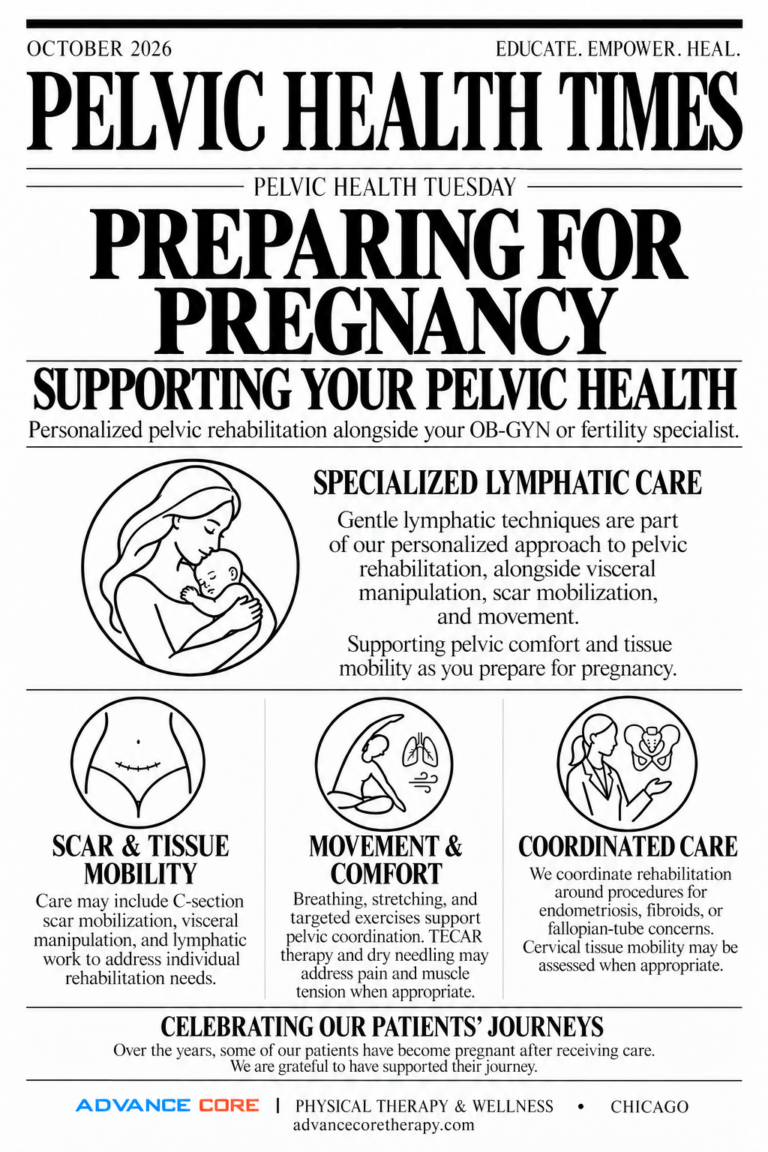
Preparing for pregnancy is a personal journey. If you have a history of C-section delivery, pelvic surgery, or pelvic pain, you may also be wondering how to address scar discomfort, muscle tension, or difficulty moving comfortably.
At Advance Core Physical Therapy & Wellness in Lincoln Square, Chicago, we offer individualized pelvic rehabilitation alongside your OB-GYN or fertility specialist. Our approach considers the pelvic floor, breathing, abdominal wall, scars, and whole-body movement. The goal is to support your comfort and function while you pursue your reproductive goals.
Our clinical experience: supporting women alongside fertility treatment
Over the years, we have supported women preparing for pregnancy, including patients undergoing IVF. We have had the joy of seeing some of these patients become pregnant and welcome their babies after receiving care. Their experiences have strengthened our interest in how pelvic rehabilitation may complement medical fertility treatment.
One patient had undergone several unsuccessful IVF attempts. After receiving scar mobilization and hands-on pelvic rehabilitation before a subsequent attempt, she became pregnant through IVF, continued the pregnancy, and delivered her baby.
Her subsequent pregnancy and delivery were meaningful milestones for her and for our team. Experiences like this encourage us to discuss supportive rehabilitation options with women and their fertility specialists.
These experiences motivate us to inform more women about pelvic rehabilitation. Scar discomfort, pelvic muscle tension, and restricted movement deserve attention during the fertility journey. We aim to address these needs while coordinating with the OB-GYN or fertility specialist, rather than asking patients to choose between rehabilitation and medical care.
Our clinical experience informs individualized care, and published research helps us explain what has been studied. Together, they encourage thoughtful discussion about how pelvic rehabilitation may fit into a broader fertility care plan.
What can pelvic physical therapy address?
Your evaluation begins with your symptoms, medical and surgical history, and the activities that matter to you. We assess movement, breathing, pelvic floor coordination, and scar sensitivity or restrictions. Internal assessment is performed only when indicated and with your informed consent.
Depending on your needs, your care plan may include:
C-section scar mobilization to address scar sensitivity and restricted movement after healing.
Gentle visceral manipulation directed at mobility of the tissues surrounding abdominal and pelvic organs.
Specialized lymphatic techniques when swelling or fluid-management needs are identified.
Breathing retraining, stretching, and personalized exercises for pelvic floor relaxation, coordination, and comfortable movement.
TECAR therapy or dry needling for appropriate pain and muscle-related rehabilitation needs.
These options are chosen according to your assessment, medical history, and treatment stage. No single technique is appropriate for everyone.
What does the research on fertility show?
Published studies have explored manual physical therapy in women experiencing infertility. The following three studies provide context for this developing area of research.
Combined manual therapy and lymphatic drainage: a 2012 case series
A study featured by Chikly Health Institute followed ten women experiencing infertility who received one to six sessions of combined manual therapy. Techniques included visceral manipulation, lymphatic drainage, and muscle-energy techniques. Six women conceived within three months of their last treatment session, and all six delivered at full term. [1]
This is the study most directly related to the combination of lymphatic work and visceral manipulation. However, it had only ten participants and no control group. It cannot establish that treatment caused pregnancy or determine whether lymphatic drainage, visceral manipulation, or another factor contributed to the outcomes.
Manual soft-tissue therapy and pregnancy: a 2004 study
An earlier study enrolled 53 women with infertility and histories suggesting abdominal or pelvic adhesions. Participants received a specific manual soft-tissue treatment protocol. Among 14 women available for follow-up in the natural-conception group, ten became pregnant within one year. The IVF group was compared with historical national data rather than a concurrently randomized control group. [2]
The results prompted further investigation, but the small sample, incomplete follow-up, and comparison method limit the conclusions. Outcomes from this specific protocol cannot be assumed to apply to all manual therapy approaches.
A larger retrospective review: 2015
A retrospective chart review examined 1,392 women treated at a private physical therapy clinic between 2002 and 2011. It reported pregnancy and other reproductive outcomes across several infertility diagnoses following a specific manual therapy protocol. [3]
The larger sample adds observations, but a retrospective review does not provide the certainty of a randomized controlled trial. Without a suitable comparison group, it cannot isolate the treatment’s effects from other influences.
These findings are encouraging, but they do not establish that adding manual therapy increases conception or live-birth rates. TECAR therapy and dry needling were not evaluated in these studies and are used in our care for appropriate rehabilitation needs.
Coordinating care with your OB-GYN or fertility specialist
Pelvic rehabilitation may be incorporated before or after medically indicated procedures related to endometriosis, fibroids, or fallopian-tube concerns. Your medical team determines the diagnosis, procedure, and timing. We tailor rehabilitation to your symptoms, healing stage, and medical clearance.
Our role is to address rehabilitation needs such as pain, muscle tension, scar sensitivity, and movement limitations. When appropriate, assessment may also consider surrounding pelvic tissue mobility. Diagnosis and medical treatment of tubal disease, fibroids, and endometriosis remain with your medical team.
Pelvic rehabilitation should proceed alongside timely medical evaluation. ASRM recommends evaluation after 12 months of trying to conceive for women under 35 and after six months for women 35 or older. For women over 40, more immediate evaluation may be warranted; known conditions associated with infertility also call for earlier assessment. [4]
Care that respects your individual journey
We believe women deserve compassionate support and clear information about the options available to them. Your symptoms, treatment history, medical plan, and personal goals guide our care.
Every pregnancy journey is different. We celebrate our patients’ milestones while respecting the complexity of conception and pregnancy. Our focus remains on supporting pelvic comfort and function throughout that journey.
Personalized pelvic care in Lincoln Square, Chicago
If scar discomfort, pelvic pain, or muscle tension is affecting you as you prepare for pregnancy, a pelvic physical therapy evaluation can help identify your rehabilitation needs. We work with you and your medical team to build a plan that respects your goals, comfort, and privacy.
Advance Core Physical Therapy & Wellness
5300 North Lincoln Avenue, Suite A, Chicago, IL 60625
(773) 982-9735
This article provides educational information and does not replace individualized medical advice.
References and further reading
1. Kramp ME. Combined Manual Therapy Techniques for the Treatment of Women With Infertility: A Case Series. J Am Osteopath Assoc. 2012;112(10):680–684.
Chikly Health Institute: study summary and lymph drainage research resource.
2. Wurn BF, et al. Treating Female Infertility and Improving IVF Pregnancy Rates With a Manual Physical Therapy Technique. MedGenMed. 2004;6(2):51.
3. Rice AD, et al. Ten-year Retrospective Study on the Efficacy of a Manual Physical Therapy to Treat Female Infertility. Altern Ther Health Med. 2015;21(3):36–44.
4. American Society for Reproductive Medicine. Fertility Evaluation of Infertile Women: A Committee Opinion. 2021.